“Ring of Fire” Solar Eclipse Tonight!
- Eileen Dey Wurst

- May 20, 2012
- 2 min read
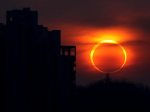
Like a total solar eclipse, an annular eclipse happens when the moon lines up between Earth and the sun. But in this case, the dark moon’s apparent diameter is smaller than the visible disk of the sun, leaving a ring—or annulus—of fiery light around the edges. (See annular eclipse pictures.)
During such an eclipse, “the path of annularity, where the full eclipse will be visible, is hundreds of miles wide and thousands of miles long,” said eclipse expert Jay Pasachoff, the Field Memorial Professor at Williams College in Massachusetts.
In this path, “viewers looking through special solar filters can see a ring of sunlight around the black silhouette of the moon,” said Pasachoff, who is also a National Geographic Society grantee. (National Geographic News is a division of the Society.)
The annular eclipse starts in China at local sunrise on May 21. The path of the moon’s shadow then goes over Japan around 7:35 a.m., local time, and races across the Pacific Ocean.
Due to the time zone change, the eclipse makes landfall again in North America in the late afternoon of May 20, starting at the California-Oregon border at 6:26 p.m. PT.
The annular eclipse then crosses southern Nevada, southern Utah, the Grand Canyon in northern Arizona, the lower-left corner of Colorado, and most of New Mexico before ending in the area of Lubbock, Texas, around sunset at 8:36 p.m. CT.
For most viewers in the path of annularity, the eclipse will last for a just over four and half minutes.
Active Sun to Add Beauty to Eclipse
Some picturesque wilderness areas—including several U.S. national parks—will be in the 190-mile-wide (300-kilometer-wide) path of the full annular eclipse.
Viewers in a broader track stretching for thousands of miles across northeastern Asia and the western two-thirds of the U.S. and Canada will instead see a striking partial eclipse.
“Unlike a total eclipse, in which the sun is entirely covered and the sky therefore gets dark, it never gets dark during an annular eclipse like this one,” Pasachoff said.
“So the only loss in view from being off to the side of the zone of totality is that you won’t see a complete ring and things won’t appear symmetric, but you’ll still be able to see a partial eclipse of the sun.”
(See partial eclipse pictures.)
The best chances for clear skies during the event will be in states such as Nevada, Arizona, and Utah, added Anthony Cooke, an astronomer at the Griffith Observatory in Los Angeles.
“But most of the path in the Western U.S. has better than even odds of clear enough weather to observe the eclipse,” he said.



Comments